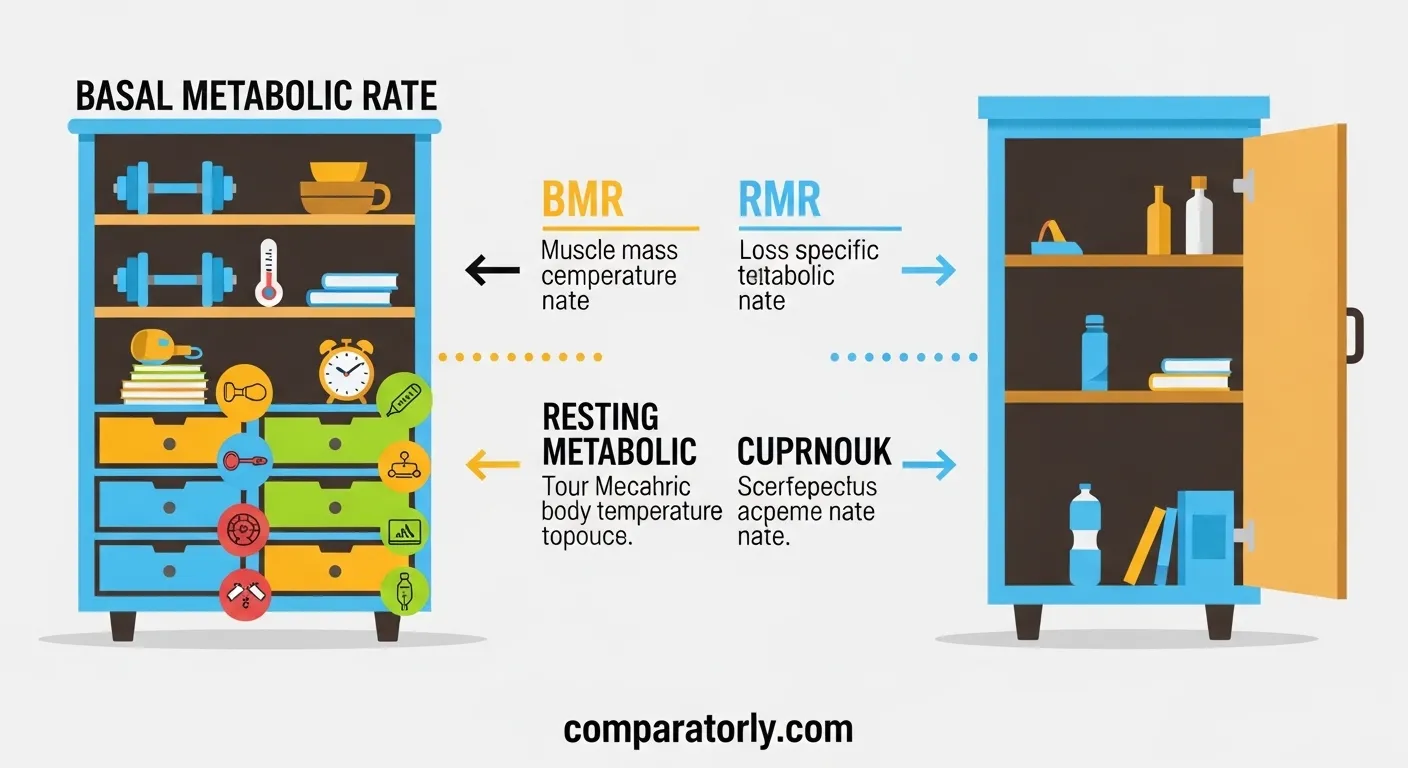
BMR (Basal Metabolic Rate) and RMR (Resting Metabolic Rate) are crucial measurements for understanding how your body burns calories.
BMR represents the number of calories your body needs to maintain basic functions like breathing and circulation while at complete rest,
whereas RMR measures calories burned at rest but can include minimal daily activity.
Knowing the difference helps fitness enthusiasts, nutritionists, and health professionals plan diets, exercise routines, and manage weight effectively.
Understanding these rates ensures smarter health and lifestyle decisions.
Key Difference Between the Both
The main difference between BMR and RMR is related to measurement conditions.
- BMR measures the minimum energy needed to keep the body alive under very strict conditions.
- RMR measures energy burned at rest but under more relaxed and realistic conditions.
In simple terms, BMR is more precise but harder to measure, while RMR is easier to measure and commonly used in fitness programs.
Why Their Difference Is Important for Learners and Experts
Understanding the difference between BMR and RMR is important in many areas of society.
For students and learners
- Helps them understand human metabolism.
- Useful in biology and nutrition studies.
- Improves knowledge about calorie needs.
For health professionals
- Nutritionists design accurate diet plans.
- Doctors assess metabolic health.
- Trainers calculate calorie burn.
society
- Supports healthy lifestyles.
- Helps prevent obesity.
- Improves awareness about body energy use.
Knowing the difference between BMR and RMR allows individuals and professionals to make better health decisions.
Difference Between BMR and RMR
Below are ten clear points that explain the difference between BMR and RMR. Each point includes simple explanations and examples.
1. Definition
BMR
The minimum energy the body needs to survive.
Examples:
- Energy used to keep the heart beating.
- Energy needed for breathing.
RMR
Energy the body burns while resting but not under strict conditions.
Examples:
- Calories burned while sitting quietly.
- Energy used when lying down after waking up.
2. Measurement Conditions
BMR
Measured under strict laboratory conditions.
Examples:
- After 8 hours of sleep.
- After 12 hours of fasting.
RMR
Measured under relaxed conditions.
Examples:
- At a clinic during normal rest.
- Without strict fasting requirements.
3. Accuracy
BMR
More accurate and scientific.
Examples:
- Used in research studies.
- Used in metabolic laboratories.
RMR
Slightly less precise but practical.
Examples:
- Used in gyms.
- Used in fitness apps.
4. Testing Difficulty
BMR
Harder to measure.
Examples:
- Requires controlled environment.
- Requires special equipment.
RMR
Easier to measure.
Examples:
- Measured with simple metabolic tests.
- Often estimated using formulas.
5. Energy Value
BMR
Usually slightly lower than RMR.
Examples:
- A person may have 1500 BMR calories.
- Another person may have 1400 BMR calories.
RMR
Usually 10% higher than BMR.
Examples:
- Same person may have 1650 RMR calories.
- Another person may have 1550 RMR calories.
6. Usage in Diet Planning
BMR
Examples:
- Used in scientific nutrition plans.
- Used for medical assessments.
RMR
Examples:
- Used by personal trainers.
- Used in weight-loss programs.
7. Real-Life Application
BMR
Examples:
- Used in clinical research.
- Used in metabolic disease studies.
RMR
Examples:
- Used in fitness coaching.
- Used in daily calorie calculations.
8. Body State
BMR
Examples:
- Body completely relaxed.
- No recent activity.
RMR
Examples:
- Body resting but not fully controlled.
- May include light activity before testing.
9. Measurement Environment
BMR
Examples:
- Quiet laboratory setting.
- Temperature-controlled room.
RMR
Examples:
- Clinic room.
- Fitness center.
10. Practical Popularity
BMR
Examples:
- Popular in medical research.
- Used in academic studies.
RMR
Examples:
- Popular in health apps.
- Used in calorie calculators.
Nature and Behaviour of Both
Nature of BMR
BMR reflects the body’s basic survival energy. It supports essential processes like breathing, circulation, and cell production.
BMR remains relatively stable but changes with age, muscle mass, and genetics.
Nature of RMR
RMR reflects real-life resting energy use. It includes basic body functions plus small daily movements or digestion.
RMR changes slightly based on daily activities and lifestyle.
Why People Are Confused About Their Use
Several reasons cause confusion between BMR and RMR.
- Both measure calories burned at rest.
- The terms sound very similar.
- Many fitness apps use them interchangeably.
- The difference between them is small (often about 10%).
- People rarely see the actual lab testing process.
Because of these reasons, many people do not notice the difference between BMR and RMR.
Table Showing Difference and Similarity
| Feature | BMR | RMR | Similarity |
| Meaning | Basal metabolic rate | Resting metabolic rate | Both measure energy use |
| Testing | Strict laboratory conditions | Relaxed conditions | Both measured at rest |
| Accuracy | Highly accurate | Slightly less precise | Both estimate calories |
| Difficulty | Harder to measure | Easier to measure | Both need metabolic formulas |
| Energy value | Lower | Slightly higher | Both represent daily calorie needs |
| Usage | Research and medicine | Fitness and diet planning | Both help manage weight |
Which Is Better in What Situation?
When BMR Is Better
BMR is better in scientific or medical situations. Researchers studying metabolism need exact measurements of energy use. Doctors may also use BMR to understand metabolic disorders. Because it is measured under strict conditions, BMR provides the most accurate baseline for body energy requirements.
When RMR Is Better
RMR is more useful for everyday health planning. Trainers and nutritionists often use RMR because it is easier to measure and closer to real-life conditions. Fitness apps and calorie calculators usually rely on RMR estimates to help people manage weight, track calorie intake, and plan exercise routines.
How the Words Are Used in Metaphors and Similes
Even though BMR and RMR are scientific terms, they can appear metaphorically.
Examples
- Creativity is the BMR of innovation, always running quietly in the background.
- Motivation is like your RMR, burning energy even when you rest.
These metaphors show constant inner activity.
Connotative Meaning
BMR
Connotation: Neutral / Scientific
Examples:
- The doctor calculated his BMR before planning treatment.
- Athletes monitor BMR to understand metabolism.
RMR
Connotation: Neutral / Practical
Examples:
- Her trainer measured RMR to design a diet plan.
- Fitness apps estimate RMR automatically.
Idioms or Proverbs Related to the Words
Since BMR and RMR are technical terms, direct idioms are rare. However, related expressions about energy or metabolism exist.
Examples
- Burning energy like a furnace.
Example: After exercise, his body was burning energy like a furnace. - Running on idle.
Example: On weekends, my brain feels like it’s running on idle.
These phrases loosely connect to resting energy use.
Works in Literature Featuring the Keywords
Although scientific terms appear rarely in literature, they appear in health and science books.
- Metabolism Revolution – Health Science – Haylie Pomroy – 2013
- Why Zebras Don’t Get Ulcers – Biology – Robert Sapolsky – 1994
- The Obesity Code – Nutrition – Jason Fung – 2016
These works discuss metabolism concepts including BMR and RMR.
Movies Related to Metabolism and Body Science
Films sometimes explore metabolism and body science themes.
- Super Size Me – 2004 – USA
- Fed Up – 2014 – USA
- That Sugar Film – 2014 – Australia
These documentaries discuss metabolism and calorie use in the body.
FAQs
1. What is the main difference between BMR and RMR?
BMR measures energy under strict conditions, while RMR measures energy at rest in normal conditions.
2. Is RMR higher than BMR?
Yes. RMR is usually about 10% higher because it includes more real-life body activity.
3. Which one do fitness apps use?
Most apps use RMR because it is easier to estimate.
4. Can exercise change BMR or RMR?
Yes. Exercise can increase muscle mass, which raises both BMR and RMR.
5. Why are both important?
They help people understand daily calorie needs and maintain healthy weight.
How Both Are Useful for Our Surroundings
BMR and RMR knowledge benefits society in many ways.
- Helps doctors treat metabolic disorders.
- Helps nutritionists plan balanced diets.
- Helps fitness trainers design workout plans.
- Encourages people to understand calorie balance.
When people know how their body uses energy, they can build healthier habits.
Final Words for Both
BMR and RMR are essential tools for understanding metabolism. While BMR represents the body’s most basic energy requirement, RMR reflects practical energy use in daily life. Together, they give a complete picture of how the body burns calories and maintains life.
Conclusion
Understanding the difference between BMR and RMR helps people make smarter health decisions.
BMR describes the minimum energy the body needs to survive under strict conditions, while RMR measures energy burned during normal rest.
Although their values are similar, their measurement methods and uses differ.
BMR is mainly used in research and medical studies, while RMR is commonly used in fitness and nutrition planning.
By learning the difference between BMR and RMR, individuals can better estimate daily calorie needs, improve diet strategies, and maintain healthy lifestyles.
In a world where metabolic health is becoming increasingly important, these two concepts offer valuable insight into how the human body functions.

Hi, I’m Ayaan Mercer. I specialize in word comparison articles and SEO-focused language guides. I enjoy breaking down confusing word pairs like “affect vs effect” or “discrete vs continuous” into simple, practical explanations. My goal is to help students, bloggers, and professionals write with clarity and confidence. I focus on clean structure, real-life examples, and search intent optimization to make English easier for everyone.