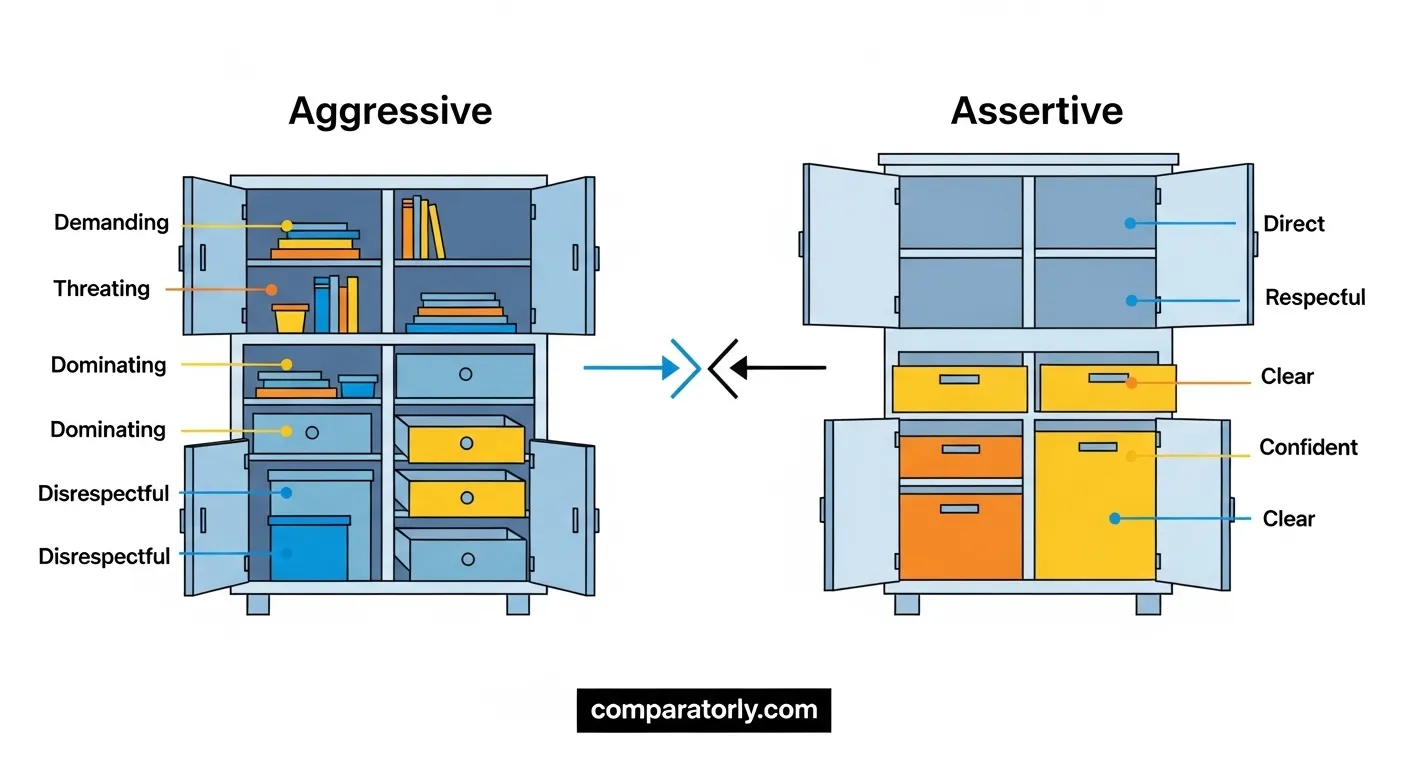
Understanding the difference between aggressive and assertive behavior is important for effective communication, as assertiveness expresses needs confidently and respectfully, while aggression often involves forceful or hostile actions that can harm relationships and create conflict.
Difference Between Aggressive and Assertive
Here are the 5 main points that distinguish aggressive and assertive behavior:
- Communication Style
- Aggressive: Dominating, loud, and sometimes threatening.
- Example 1: Give me the report now, or else!
- Example 2: Yelling at a colleague to complete their task immediately.
- Assertive: Clear, firm, but respectful.
- Example 1: I need the report by 5 PM. Can you manage that?
- Example 2: Politely asking a teammate to review a document.
- Aggressive: Dominating, loud, and sometimes threatening.
- Expression of Feelings
- Aggressive: Overpowers others to vent frustration.
- Example 1: Slamming the door angrily in a disagreement.
- Example 2: Interrupting someone to express dissatisfaction.
- Assertive: Expresses feelings honestly without harming others.
- Example 1: I feel concerned about the delay in the project.
- Example 2: Sharing personal opinions calmly during a discussion.
- Aggressive: Overpowers others to vent frustration.
- Respect for Others
- Aggressive: Shows little to no respect for others’ rights.
- Example 1: Taking credit for a team member’s work.
- Example 2: Ignoring someone’s viewpoint in a meeting.
- Assertive: Respects others while standing one’s ground.
- Example 1: Acknowledging team input but stating a differing opinion.
- Example 2: Negotiating tasks without offending anyone.
- Aggressive: Shows little to no respect for others’ rights.
- Body Language
- Aggressive: Intimidating gestures, pointing fingers, glaring.
- Example 1: Standing too close during an argument.
- Example 2: Fist-clenching while talking to someone.
- Assertive: Confident posture, eye contact, open gestures.
- Example 1: Standing straight while addressing a group.
- Example 2: Using calm hand gestures to emphasize a point.
- Aggressive: Intimidating gestures, pointing fingers, glaring.
- Conflict Handling
- Aggressive: Creates conflict, often escalates tension.
- Example 1: Shouting during a debate.
- Example 2: Refusing to compromise in negotiations.
- Assertive: Resolves conflict with understanding and compromise.
- Example 1: Discussing differing opinions calmly.
- Example 2: Suggesting solutions that satisfy all parties.
- Aggressive: Creates conflict, often escalates tension.
Nature and Behavior
Aggressive:
- Dominating, controlling, sometimes hostile.
- Can damage relationships and create stress.
- Seeks to win rather than collaborate.
Assertive:
- Confident, respectful, and balanced.
- Builds trust and effective communication.
- Seeks win-win solutions and mutual understanding.
Why People Are Confused About Their Use
Many confuse aggressive and assertive because both involve standing up for oneself. However, the key difference lies in respect and intent. Aggression violates boundaries, while assertiveness honors them. Misunderstanding these terms can lead to poor communication and strained relationships.
Comparison Table: Aggressive vs Assertive
| Feature | Aggressive | Assertive | Similarity |
| Communication Style | Loud, threatening | Firm, respectful | Both express opinions |
| Respect for Others | Low | High | Both assert themselves |
| Body Language | Intimidating, hostile | Confident, open | Both use non-verbal cues |
| Conflict Handling | Escalates tension | Resolves with compromise | Both influence outcomes |
| Emotional Impact | Fear, resentment | Cooperation, respect | Both affect others’ feelings |
| Decision Approach | Imposes | Collaborates | Both make choices |
| Tone of Voice | Harsh, commanding | Calm, confident | Both communicate verbally |
| Motivation Style | Intimidation | Encouragement | Both aim to influence people |
| Focus on Outcome | Self-centered | Mutual benefit | Both achieve goals |
| Social Perception | Negative | Positive | Both are noticeable behaviors |
Which is Better in What Situation?
Aggressive behavior can sometimes be effective in emergencies, strict rules enforcement, or urgent decision-making. For instance, in a crisis, a firm, commanding approach may prevent chaos.
Assertive behavior, however, is ideal for daily life, professional settings, and healthy relationships. Assertiveness promotes understanding, reduces conflict, and encourages mutual respect, making it more sustainable for long-term communication.
Use in Metaphors and Similes
- Aggressive: He was like a storm, leaving everyone shaken.
- Assertive: She spoke like a lighthouse, guiding without overwhelming.
Connotative Meaning
- Aggressive – Negative → Example: His aggressive tone scared the team.
- Assertive – Positive → Example: Her assertive approach resolved the issue quickly.
Idioms and Proverbs
- Aggressive: Throw one’s weight around → Example: He tends to throw his weight around at work.
- Assertive: Stand one’s ground → Example: She stood her ground during the debate.
Works in Literature
- Aggressive – Lord of the Flies (Novel, William Golding, 1954)
- Assertive – Pride and Prejudice (Novel, Jane Austen, 1813)
Movies
- Aggressive – Gladiator (2000, USA)
- Assertive – Erin Brockovich (2000, USA)
FAQs
- Can assertive behavior become aggressive?
- Yes, if boundaries are ignored or tone becomes harsh.
- Is aggression always harmful?
- Usually, but in urgent scenarios, controlled aggression can work.
- How to develop assertiveness?
- Practice clear communication, maintain respect, and use calm body language.
- Why are people confused between these terms?
- Both involve self-expression, but intent and respect differentiate them.
- Which is more socially acceptable?
- Assertiveness is widely accepted and admired in society.
How Both Are Useful for Surroundings
- Aggressive behavior can push immediate results or enforce discipline.
- Assertive behavior encourages cooperation, clarity, and harmony.
- Both, when understood correctly, help navigate social and professional spaces effectively.
Final Words
Understanding the difference between aggressive and assertive is crucial for effective communication. Aggression can intimidate, while assertiveness empowers. Choosing the right approach enhances relationships and personal growth.
Conclusion
In conclusion, the distinction between aggressive and assertive behavior affects how we interact, resolve conflicts, and achieve goals.
Aggression may bring temporary results but risks damaging relationships. Assertiveness fosters trust, respect, and constructive communication.
By recognizing these traits in ourselves and others, we can cultivate better social and professional environments.
Whether in workplaces, families, or communities, mastering assertive behavior ensures healthy interactions while understanding aggression helps manage challenges strategically.

I am Ayesha Rahman, and I focus on spelling differences and common English mistakes. I write clear guides about British vs American English spellings. My mission is to remove confusion from daily writing. I believe every learner deserves simple explanations and real examples.