A family leaves their home overnight.
They cross borders with nothing but hope.
Are they called refugees or asylees?
This real-world situation shows why people often search for the difference between refugee and asylee.
The terms sound similar. Both describe people escaping danger.
Yet, there is a legal and practical difference. Understanding the difference between refugee and asylee helps students, writers, and professionals use the right word.
It also helps us understand global migration better.
Many learners struggle with the difference between refugee and asylee because both involve fear, safety, and protection.
However, the main difference lies in where and how a person applies for protection.
In this article, you will learn the difference between refugee and asylee in simple words, with examples, tables, and real-life uses.
Key Difference Between Refugee and Asylee
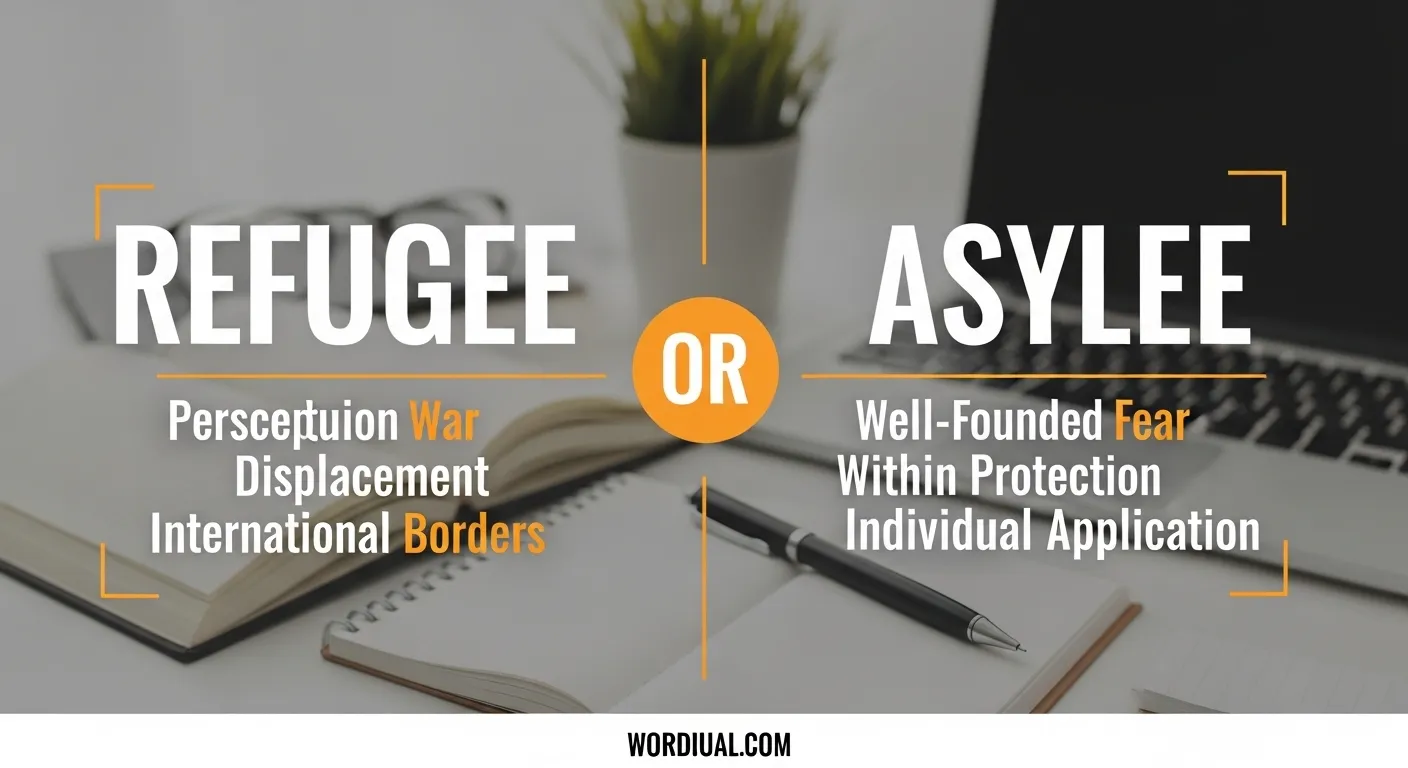
The key difference is simple:
- A refugee applies for protection outside the country they want to enter.
- An asylee applies for protection inside the country or at its border.
👉 Example:
- A Syrian family waiting in another country = Refugees
- The same family applying after reaching the USA = Asylees
Why Is Their Difference Important for Learners and Experts?
Understanding the difference between refugee and asylee is important for many reasons:
- 📚 For students → It improves vocabulary and global awareness
- ⚖️ For legal experts → It helps in immigration law decisions
- 📰 For journalists → It ensures correct reporting
- 🌍 For society → It builds empathy and clarity
Using the wrong term can cause confusion. In serious topics like migration, words matter a lot.
Pronunciation (US & UK)
- Refugee
- US: /ˌref.jʊˈdʒiː/
- UK: /ˌref.juːˈdʒiː/
- Asylee
- US: /əˌsaɪ.liː/
- UK: /əˌsaɪ.liː/
👉 Both are easy to say once you break them into parts.
Let’s Dive Deeper…
Now that you know the basics, let’s explore the full difference between refugee and asylee with detailed points and examples.
Difference Between Refugee and Asylee (10 Detailed Points)
1. Place of Application
- Refugee → Applies outside the country
- Asylee → Applies inside the country
Examples:
- Refugee: Waiting in Turkey for approval
- Refugee: Registered with UN office abroad
- Asylee: Applies at US airport
- Asylee: Submits claim after entering UK
2. Legal Process
- Refugee → Processed before entry
- Asylee → Processed after arrival
Examples:
- Refugee: Approved before travel
- Refugee: Travels legally after approval
- Asylee: Applies after crossing border
- Asylee: Waits for decision inside country
3. Entry Status
- Refugee → Enters legally with permission
- Asylee → May enter first, then apply
Examples:
- Refugee: Gets visa first
- Refugee: Travels by resettlement program
- Asylee: Enters on tourist visa
- Asylee: Applies for asylum later
4. Government Involvement
- Refugee → Approved by international agencies
- Asylee → Approved by national government
Examples:
- Refugee: Reviewed by UNHCR
- Refugee: Accepted by resettlement country
- Asylee: Reviewed by immigration court
- Asylee: Approved by local authorities
5. Processing Time
- Refugee → Often longer before entry
- Asylee → Can vary after entry
Examples:
- Refugee: Waits years in camps
- Refugee: Long screening process
- Asylee: Case decided in months or years
- Asylee: May stay during process
6. Travel Situation
- Refugee → Travels after approval
- Asylee → Already present in country
Examples:
- Refugee: Travels by plane legally
- Refugee: Organized relocation
- Asylee: Crosses border
- Asylee: Applies at checkpoint
7. Support Programs
- Refugee → Gets resettlement support
- Asylee → May apply for support later
Examples:
- Refugee: Housing and job help
- Refugee: Language classes
- Asylee: Limited early support
- Asylee: Applies for benefits later
8. Documentation
- Refugee → Gets documents before arrival
- Asylee → Gets documents after approval
Examples:
- Refugee: Travel papers issued
- Refugee: Approved visa
- Asylee: Receives asylum status later
- Asylee: Gets work permit
9. Risk Level at Entry
- Refugee → Safer entry process
- Asylee → May face risks
Examples:
- Refugee: Organized travel
- Refugee: Safe relocation
- Asylee: Risky border crossing
- Asylee: Uncertain entry
10. Recognition Timing
- Refugee → Recognized before entering
- Asylee → Recognized after entering
Examples:
- Refugee: Status confirmed early
- Refugee: Travels with approval
- Asylee: Status pending
- Asylee: Waits for decision
Nature and Behaviour
Refugee:
- Often more planned movement
- Travels through official channels
- Depends on international systems
Asylee:
- Often urgent and unplanned
- May arrive suddenly
- Seeks protection quickly
Why Are People Confused?
- Both escape danger
- Both seek protection
- Words sound similar
- Media sometimes mixes terms
👉 Simple fix: Remember location of application.
Comparison Table
| Feature | Refugee | Asylee | Similarity |
| Application place | Outside country | Inside country | Both seek safety |
| Legal status | Before entry | After entry | Both protected |
| Risk level | Lower | Higher | Both face danger |
| Approval | International | National | Legal process |
| Goal | Safety | Safety | Same purpose |
Which Is Better in What Situation?
Refugee (Better Situation)
Refugee status is better when a person can apply safely from another country. It offers a structured and safer path. People get support before travel. It reduces risk and uncertainty.
Asylee (Better Situation)
Asylee status is better when a person must escape urgently. If waiting is dangerous, applying inside a country is the only option. It allows quick protection.
Metaphors and Similes
- Refugee → Like a traveler waiting at the gate for permission
- Asylee → Like a runner seeking shelter during a storm
Connotative Meaning
Refugee:
- Positive → Survivor, strong
- Negative → Displaced, helpless
- Neutral → Migrant
Example:
- The refugee showed courage.
Asylee:
- Positive → Brave, hopeful
- Negative → Uncertain, struggling
- Neutral → Applicant
Example:
- The asylee waited patiently.
Idioms and Usage
(No direct idioms, but related phrases)
- Seek refuge → Find safety
- Safe haven → Protected place
Examples:
- They sought refuge in a new land.
- The country became a safe haven.
Works in Literature
- Refugee by Alan Gratz (Novel, 2017)
- Exit West by Mohsin Hamid (Fiction, 2017)
Movies on the Topic
- The Swimmers (2022, UK)
- The Good Lie (2014, USA)
FAQs
1. What is the main difference between refugee and asylee?
A refugee applies outside, while an asylee applies inside a country.
2. Are both legally protected?
Yes, both receive legal protection under international law.
3. Can a refugee become an asylee?
No, but both can later become permanent residents.
4. Which is safer?
Refugee status is usually safer due to planned entry.
5. Why are the terms mixed?
Because both involve fleeing danger and seeking safety.
How Both Are Useful for Society
- They bring cultural diversity
- They contribute to the economy
- They share global experiences
- They strengthen human values
Final Words for Both
Refugees and asylees are not just terms. They represent human stories of struggle and hope. Understanding them builds empathy and knowledge.
Conclusion
The difference between refugee and asylee is simple but important. It depends on where a person applies for protection.
Refugees apply from outside, while asylees apply from inside a country.
Both groups face hardship. Both seek safety. Yet, their legal paths are different. Knowing this difference helps in education, law, and communication.
Clear understanding improves writing and awareness. It also helps us respect the journey of those seeking a better life.

I am Sarah Whitmore, an English grammar specialist at Comparatorly.com. I love breaking complex grammar rules into simple and clear explanations. My focus is on confusing word pairs like “affect vs effect” and “cancelation vs cancellation.” I believe grammar should feel easy, not stressful. My goal is to help students and writers build strong, confident English skills.