Imagine a student who arrives late to school. When the teacher asks why, the student says, The bus broke down.
Another student says, I woke up late. Both statements explain something, but one may sound like a reason, while the other may feel like an excuse.
This simple situation shows why people often search for the difference between reason and excuse.
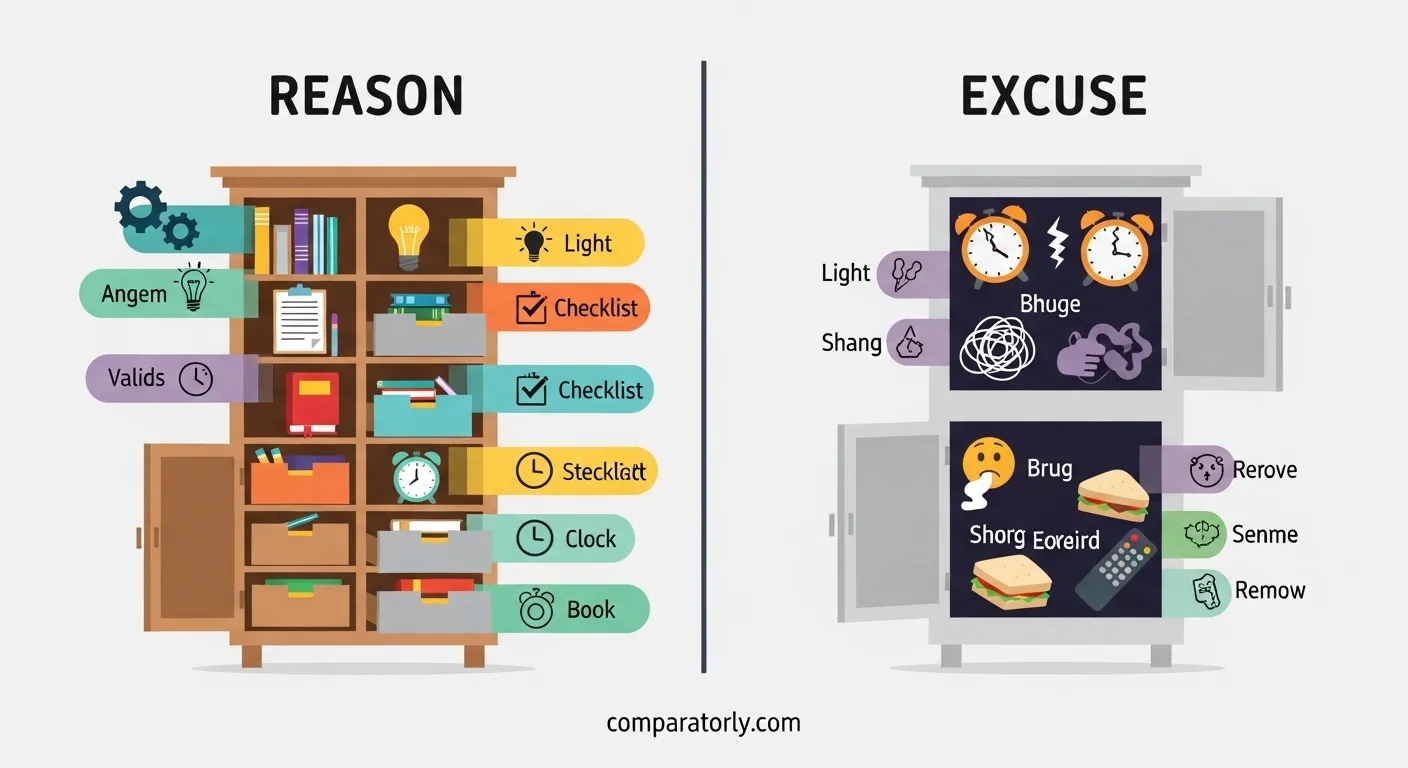
A reason explains the real cause behind an action or situation.
It gives logical understanding. An excuse, on the other hand, often tries to justify or avoid responsibility for something.
The difference between reason and excuse becomes important in daily life, communication, and decision-making. Many people mix them because both are explanations.
Understanding the difference between reason and excuse helps us communicate honestly and build trust.
In workplaces, schools, and relationships, knowing the difference between reason and excuse can shape how people judge our intentions and actions.
Before we explore deeper comparisons, let’s look at how these two words sound.
Pronunciation
| Word | US Pronunciation | UK Pronunciation |
| Reason | /ˈriːzən/ | /ˈriːzən/ |
| Excuse | /ɪkˈskjuːs/ (verb), /ɪkˈskjuːs/ | /ɪkˈskjuːs/ |
Both words sound clear but carry different intentions.
Now let’s explore the deeper meaning and the real difference between them.
Difference Between Reason and Excuse
Below are ten clear differences explained in simple language.
1. Purpose of Explanation
Reason
A reason explains the true cause behind an action.
Examples:
- She missed the meeting because her child was sick.
- He left early because he had a medical appointment.
Excuse
An excuse tries to avoid blame or responsibility.
Examples:
- I forgot my homework because my dog ate it.
- I couldn’t study because the weather was too hot.
2. Honesty Level
Reason
Reasons are usually honest and factual.
Examples:
- The train was delayed due to technical issues.
- The project was late because the data was incomplete.
Excuse
Excuses may hide the truth or exaggerate it.
Examples:
- I didn’t send the email because my phone battery died.
- I couldn’t finish because the internet was slow.
3. Responsibility
Reason
A reason accepts responsibility.
Examples:
- I made a mistake because I misunderstood the instructions.
- I failed the test because I did not prepare well.
Excuse
An excuse shifts responsibility elsewhere.
Examples:
- I failed because the teacher made the test too hard.
- I lost the match because the referee was unfair.
4. Impact on Trust
Reason
Reasons build trust because they sound sincere.
Examples:
- The company delayed shipping due to supply problems.
- The worker requested leave because of family issues.
Excuse
Excuses may reduce trust.
Examples:
- The delivery was late because traffic was bad every day.
- The employee missed work because of personal issues repeatedly.
5. Emotional Tone
Reason
Reasons sound logical and calm.
Examples:
- She canceled because of a medical emergency.
- He refused because the contract was unclear.
Excuse
Excuses often sound defensive.
Examples:
- I couldn’t come because nobody reminded me.
- I didn’t know because no one told me.
6. Effect on Problem Solving
Reason
Reasons help people find solutions.
Examples:
- The machine stopped because the power failed.
- The website crashed due to heavy traffic.
Excuse
Excuses prevent solutions.
Examples:
- The machine broke because it always breaks.
- The website crashed because technology is complicated.
7. Social Perception
Reason
People respect genuine reasons.
Examples:
- She declined the offer due to family commitments.
- He refused politely because he had other plans.
Excuse
Excuses may appear irresponsible.
Examples:
- I didn’t attend because I felt lazy.
- I skipped work because I didn’t feel like it.
8. Accountability
Reason
Reasons accept accountability.
Examples:
- I forgot the report because I misread the deadline.
- The delay happened because we underestimated the time.
Excuse
Excuses avoid accountability.
Examples:
- I forgot because someone distracted me.
- The delay happened because others were slow.
9. Frequency of Use
Reason
Reasons are used when people explain facts.
Examples:
- The store closed early because of a power outage.
- Flights were canceled due to bad weather.
Excuse
Excuses are common when avoiding blame.
Examples:
- I couldn’t call because my phone was somewhere.
- I didn’t reply because I was busy all day.
10. Outcome
Reason
Reasons encourage improvement.
Examples:
- I failed because I didn’t practice enough, so I will improve.
- The team lost because of poor strategy.
Excuse
Excuses repeat mistakes.
Examples:
- I failed because the exam was unfair.
- The team lost because luck was bad.
Nature and Behaviour of Both Words
Nature of Reason
A reason is logical, factual, and constructive.
It reflects honesty and helps people understand situations clearly.
Reasons encourage learning and improvement.
Nature of Excuse
An excuse is often defensive or protective.
It may attempt to hide mistakes or reduce blame.
Excuses sometimes prevent growth because they avoid responsibility.
Why People Are Confused About Their Use
Many people confuse these two words because both explain actions.
Common causes of confusion include:
- Both answer the question Why?
- Context changes meaning.
- Tone of voice affects interpretation.
- Cultural differences influence perception.
For example, saying I was tired could be a real reason or simply an excuse depending on the situation.
Table Showing Difference and Similarity
| Aspect | Reason | Excuse | Similarity |
| Definition | Logical explanation | Justification for avoiding blame | Both explain actions |
| Honesty | Usually truthful | Sometimes doubtful | Both involve explanation |
| Responsibility | Accepts responsibility | Avoids responsibility | Both answer why |
| Tone | Logical | Defensive | Both used in communication |
| Effect | Builds trust | Reduces trust | Both influence perception |
Which Is Better in What Situation?
When Reason Is Better
Using a reason is better in professional and honest situations. When someone explains a real cause for their action, people understand and respect it. In workplaces, schools, and relationships, reasons build trust and credibility. For example, telling your manager that you missed a deadline because of a technical issue is a reason that invites solutions.
When Excuse Is Used
Excuses are sometimes used to protect feelings or avoid conflict. In casual conversations, people may use small excuses to avoid embarrassment. However, relying on excuses too often can damage credibility. In serious situations, excuses may harm relationships and professional reputation.
How the Words Are Used in Metaphors and Similes
Metaphors and similes help express deeper meanings.
Examples:
- Excuses are like clouds that hide responsibility.
- His reason was as clear as daylight.
- Excuses are smoke that hides the truth.
- Her reason stood strong like a pillar.
These comparisons show how language uses imagery to express ideas.
Connotative Meaning
Reason
Connotation: Positive or Neutral
Examples:
- Her reason helped everyone understand the problem.
- He gave a reasonable explanation.
Excuse
Connotation: Often Negative
Examples:
- Stop making excuses.
- That sounds like a weak excuse.
Idioms and Proverbs Related to These Words
Idioms with Reason
- Listen to reason
Example: The manager finally listened to reason and changed the policy. - Within reason
Example: You can spend money within reason.
Idioms with Excuse
- Excuse my French
Example: Excuse my French, but that was a terrible idea. - No excuse
Example: There is no excuse for dishonesty.
Works in Literature Using the Keywords
Reason
- The Age of Reason – Philosophy, Jean-Paul Sartre, 1945
- Critique of Pure Reason – Philosophy, Immanuel Kant, 1781
- The Sleepwalkers: How Europe Went to War in 1914 (discusses political reason), Christopher Clark, 2012
Excuse
- The Excuse – Short Story, Ramon Diaz Eterovic, 1998
- The Art of Excuse Making – Essay collection, Jay Heinrichs, 2016
Movies Related to These Words
Reason
- Reason – 2001, India (documentary style philosophical film)
Excuse
- No Excuses! – 2008, USA (motivational documentary)
FAQs
1. What is the main difference between reason and excuse?
A reason explains the real cause, while an excuse tries to justify or avoid responsibility.
2. Can a reason become an excuse?
Yes. If a person repeatedly uses the same reason to avoid responsibility, it may be seen as an excuse.
3. Are excuses always bad?
Not always. Small excuses may protect feelings in social situations.
4. Why do people make excuses?
People make excuses to protect their reputation or avoid criticism.
5. How can someone avoid making excuses?
By accepting mistakes, explaining honestly, and focusing on solutions.
How Both Are Useful for Surroundings
Both words help communication in society.
Reasons help people understand causes, solve problems, and improve decisions.
Excuses sometimes reduce social tension and protect feelings in sensitive situations.
However, balanced use is important for healthy relationships and responsible behavior.
Final Words for Both
A reason represents honesty, logic, and accountability.
An excuse often reflects avoidance, protection, or justification.
Both words explain human behavior, but their intention makes them different.
Conclusion
Understanding the difference between reason and excuse is essential in everyday communication.
A reason provides a genuine explanation for actions, while an excuse often attempts to reduce blame or responsibility.
Although both words answer the question why, their purpose and impact differ greatly.
In personal life, professional settings, and social relationships, choosing between a reason and an excuse can affect trust and credibility.
Honest reasons encourage understanding and problem-solving, while repeated excuses may damage reputation.
By learning the difference between reason and excuse, people can communicate more clearly, take responsibility for actions, and build stronger relationships.
Ultimately, honesty and accountability make reasons far more valuable than excuses in most situations.

I am Daniel Brooks, a vocabulary coach at Comparatorly.com. I specialize in synonyms, word meanings, and correct usage. I enjoy helping bloggers and content writers choose better words. My writing style is simple, practical, and easy to understand. I believe strong vocabulary creates powerful communication.