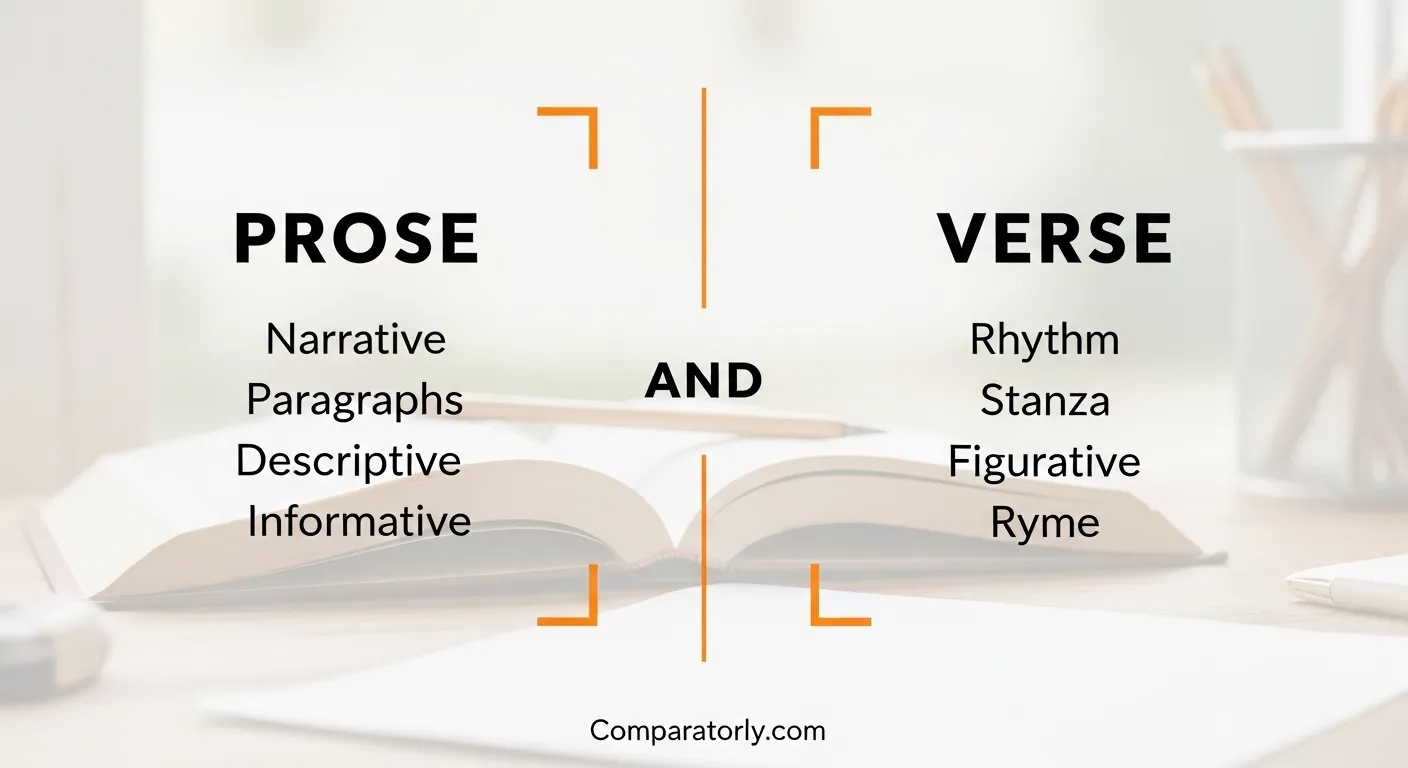
Imagine you are reading a bedtime story to a child.
The sentences flow naturally, just like everyday speech that is prose.
Now imagine reading a poem where words rhyme, follow rhythm, and create music that is verse.
This real-life moment clearly shows the difference between prose and verse.
Understanding the difference between prose and verse is important for both readers and writers.
Whether you are reading a novel, writing a poem, or studying literature, you come across both forms regularly.
The difference between prose and verse lies in structure, rhythm, and purpose, yet both aim to express ideas beautifully.
In daily life, we use prose in conversations, messages, and articles, while verse appears in poetry, songs, and emotional expressions.
Knowing the difference between prose and verse helps learners appreciate language more deeply and experts refine their craft.
Key Difference Between Prose and Verse
The main difference is simple:
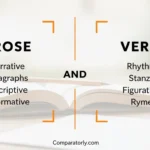
- Prose is written in ordinary language without a fixed rhythm or structure.
- Verse is written in lines with rhythm, rhyme, or meter.
Why Is Their Difference Important for Learners and Experts?
Understanding prose and verse is important because:
- It improves reading skills and comprehension.
- It helps writers choose the right form for expression.
- It enhances creativity and communication.
- It builds appreciation for literature and culture.
For society, prose shares knowledge (books, news), while verse expresses emotions (poetry, songs). Both play a vital role in shaping culture and ideas.
Pronunciation (US & UK)
- Prose
- US: /proʊz/
- UK: /prəʊz/
- Verse
- US: /vɝːs/
- UK: /vɜːs/
Linking Hook
Now that you understand the basics, let’s explore the difference between prose and verse in detail with clear points and examples.
Difference Between Prose and Verse
1. Structure
- Prose: Written in paragraphs.
- Example 1: A novel chapter
- Example 2: A newspaper article
- Verse: Written in lines and stanzas.
- Example 1: A poem with rhyming lines
- Example 2: Song lyrics
2. Rhythm
- Prose: No fixed rhythm.
- Example 1: A blog post
- Example 2: A story
- Verse: Has rhythm or meter.
- Example 1: Rhyming poem
- Example 2: Nursery rhyme
3. Language Style
- Prose: Direct and natural.
- Example 1: Emails
- Example 2: Essays
- Verse: Artistic and expressive.
- Example 1: Love poem
- Example 2: Haiku
4. Purpose
- Prose: Inform or narrate.
- Example 1: History book
- Example 2: Biography
- Verse: Express emotions.
- Example 1: Sad poem
- Example 2: Romantic poetry
5. Grammar Rules
- Prose: Follows standard grammar.
- Example 1: Academic writing
- Example 2: News articles
- Verse: May break rules for effect.
- Example 1: Poetic inversion
- Example 2: Fragmented lines
6. Rhyme
- Prose: No rhyme.
- Example 1: Short story
- Example 2: Report
- Verse: Often rhymes.
- Example 1: Twinkle, twinkle
- Example 2: Sonnet
7. Flow
- Prose: Continuous flow.
- Example 1: Novel paragraph
- Example 2: Blog article
- Verse: Broken into lines.
- Example 1: Free verse
- Example 2: Limerick
8. Creativity
- Prose: Less restricted creativity.
- Example 1: Fiction story
- Example 2: Memoir
- Verse: Highly creative.
- Example 1: Symbolic poem
- Example 2: Spoken word
9. Reading Style
- Prose: Read normally.
- Example 1: Textbook
- Example 2: Novel
- Verse: Read with rhythm.
- Example 1: Poem recitation
- Example 2: Song
10. Examples in Daily Life
- Prose: Messages, blogs, books.
- Example 1: WhatsApp message
- Example 2: News
- Verse: Songs, poetry.
- Example 1: Lyrics
- Example 2: Poems
Nature and Behaviour
Prose
- Logical and straightforward
- Focuses on clarity
- Used for communication
Verse
- Emotional and artistic
- Focuses on beauty
- Used for expression
Why People Are Confused?
People get confused because:
- Some prose contains poetic language
- Free verse has no rhyme
- Modern writing mixes both styles
Table: Difference and Similarity
| Feature | Prose | Verse | Similarity |
| Structure | Paragraphs | Lines & stanzas | Both use language |
| Rhythm | No fixed rhythm | Has rhythm | Both can be expressive |
| Purpose | Inform/narrate | Express emotions | Both communicate ideas |
| Style | Simple | Artistic | Both need creativity |
| Usage | Daily communication | Poetry and songs | Both used in literature |
Which Is Better in What Situation?
Prose
Prose is better when you need to explain ideas clearly.
It works well in education, business, and storytelling.
If your goal is clarity and detail, prose is the best choice.
Verse
Verse is better for emotions and creativity.
It is perfect for poetry, songs, and artistic expression.
If you want to touch hearts, verse is more powerful.
Metaphors and Similes
- Prose:
- Life is like a journey.
- Time flies like a bird.
- Verse:
- Her smile was the sunrise.
- Love is a burning flame.
Connotative Meanings
Prose
- Neutral
- Example: The report was written in prose.
Verse
- Positive (creative, emotional)
- Sometimes negative (complex, hard)
- Example: His verse touched my heart.
Idioms and Proverbs
- Prose before poetry (focus on basics first)
- Example: Learn grammar before writing poems
- In verse
- Example: He expressed his feelings in verse
Works in Literature
Prose
- Pride and Prejudice – Novel – Jane Austen – 1813
- 1984 – Novel – George Orwell – 1949
Verse
- The Raven – Poem – Edgar Allan Poe – 1845
- Paradise Lost – Epic Poem – John Milton – 1667
Movies Based on Prose and Verse
Prose
- Harry Potter – 2001 – UK/USA
- The Great Gatsby – 2013 – USA
Verse
- Dead Poets Society – 1989 – USA
- Bright Star – 2009 – UK
FAQs
1. What is the main difference between prose and verse?
Prose uses normal sentences, while verse uses rhythm and lines.
2. Is poetry always verse?
Yes, most poetry is written in verse.
3. Can prose be poetic?
Yes, prose can include poetic elements.
4. Which is easier to write?
Prose is easier because it follows normal language.
5. Why is verse important?
Verse expresses emotions in a powerful way.
How Both Are Useful for Surroundings
- Prose helps in communication, education, and information sharing.
- Verse adds beauty, emotion, and cultural richness.
Together, they balance logic and creativity in society.
Final Words for Both
- Prose: Clear, simple, and practical
- Verse: Emotional, artistic, and memorable
Conclusion
The difference between prose and verse is clear when we look at structure, rhythm, and purpose.
Prose is the language of everyday life, used for communication and storytelling.
Verse, on the other hand, brings rhythm and emotion, making language more artistic and expressive.
Both forms are equally important in literature and daily life. While prose helps us understand the world, verse helps us feel it.
By understanding the difference between prose and verse, learners can improve their skills, and writers can choose the best form for their message.
In the end, both prose and verse work together to make language powerful and meaningful.

I am Daniel Brooks, a vocabulary coach at Comparatorly.com. I specialize in synonyms, word meanings, and correct usage. I enjoy helping bloggers and content writers choose better words. My writing style is simple, practical, and easy to understand. I believe strong vocabulary creates powerful communication.