Imagine a child watching a cartoon where a talking dog drives a car and orders pizza.
The child laughs because the dog acts exactly like a human. Later, the same child reads a poem where the wind whispers through the trees.
Both situations give human qualities to non-human things, but they are not exactly the same.
This is where the difference between anthropomorphism and personification becomes important.
Many writers, students, and language learners often search for the difference between anthropomorphism and personification because the two concepts seem very similar.
Both involve giving human traits to animals, objects, or natural forces.
However, the difference between anthropomorphism and personification lies in how deeply those human traits are applied.
In literature, storytelling, advertising, and even daily conversation, understanding the difference between anthropomorphism and personification helps people communicate ideas more clearly.
Writers use these techniques to make stories lively, emotional, and memorable.
Learning the difference between anthropomorphism and personification also improves reading comprehension and writing skills.
So before we explore the deeper details, let us first understand their pronunciation and then move into the main comparison.
Pronunciation of Both Words
Anthropomorphism
- US: /ˌænθrəpəˈmɔːrfɪzəm/
- UK: /ˌænθrəpəˈmɔːfɪzəm/
Personification
- US: /pərˌsɑːnɪfɪˈkeɪʃən/
- UK: /pəˌsɒnɪfɪˈkeɪʃən/
These words may sound complex, but their ideas are simple. To truly understand the difference between anthropomorphism and personification, we must look at how each concept works in language and storytelling.
Key Difference Between Anthropomorphism and Personification
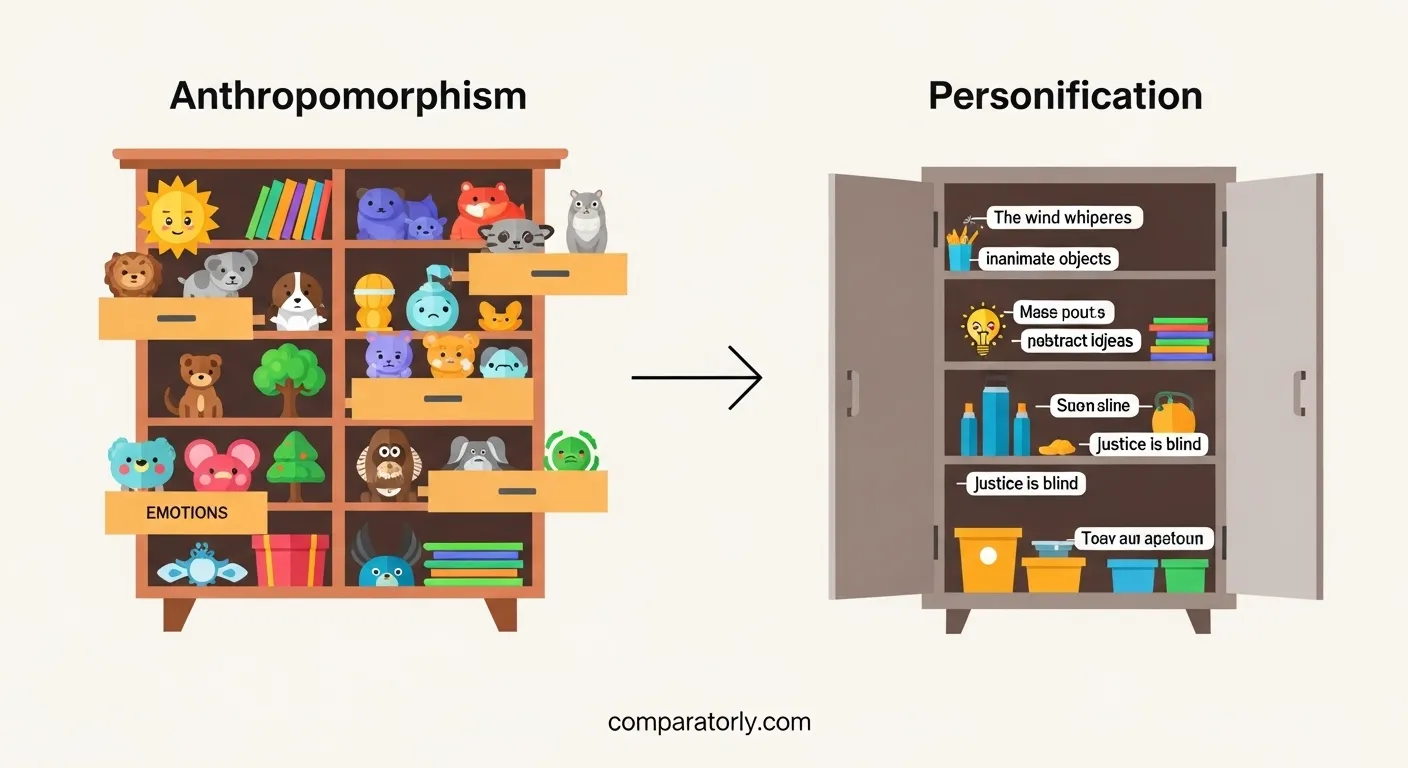
The main difference between anthropomorphism and personification is the level of human characteristics given to non-human things.
- Anthropomorphism gives animals or objects full human abilities such as speaking, thinking, dressing, or behaving like humans.
- Personification gives only a small human trait or emotion to something non-human, mainly for poetic or descriptive effect.
For example:
- Anthropomorphism: The rabbit cooked dinner and talked with his friends.
- Personification: The wind whispered through the forest.
One creates a human-like character, while the other simply adds a human quality.
Why Is Their Difference Important for Learners and Experts?
Understanding the difference between anthropomorphism and personification is valuable in many areas of society.
First, students and language learners improve their writing skills. Knowing when to use each technique helps create clearer and more expressive sentences.
Second, writers and poets rely on these tools to make stories emotional and engaging.
Third, advertisers and marketers often use anthropomorphism in mascots and brand characters to connect with audiences.
Finally, scholars and researchers study these techniques in psychology, literature, and communication. Anthropomorphism even influences how humans understand animals, technology, and nature.
Because of these reasons, recognizing the difference between anthropomorphism and personification strengthens both communication and creativity.
Difference Between Anthropomorphism and Personification
Below are ten clear differences between the two concepts.
1. Level of Human Traits
Anthropomorphism
Non-human things behave exactly like humans.
Examples:
- The fox wore a jacket and spoke politely.
- The robot complained about being tired.
Personification
Only a single human quality is given.
Examples:
- The moon smiled at the quiet lake.
- The thunder growled in the distance.
2. Purpose
Anthropomorphism
Used mainly in storytelling, cartoons, and fables.
Examples:
- Talking animals in children’s books.
- A computer assistant speaking like a human.
Personification
Used mainly in poetry and descriptive writing.
Examples:
- The sun greeted the morning.
- The leaves danced in the wind.
3. Character Creation
Anthropomorphism
Creates full characters with personalities.
Examples:
- A bear running a restaurant.
- A dog acting as a detective.
Personification
Does not create a character.
Examples:
- The angry storm attacked the coast.
- The lonely road stretched into the desert.
4. Use in Literature
Anthropomorphism
Common in fables and fantasy.
Examples:
- A lion acting as a king.
- A turtle teaching a lesson.
Personification
Common in poems and narratives.
Examples:
- The river sang softly.
- The night wrapped the city in silence.
5. Complexity
Anthropomorphism
More detailed and complex.
Examples:
- A cat planning a vacation.
- A tree writing a diary.
Personification
Simple and brief.
Examples:
- The sun smiled.
- The wind cried.
6. Emotional Expression
Anthropomorphism
Shows full emotional behavior.
Examples:
- The dog felt jealous.
- The robot celebrated its victory.
Personification
Suggests emotion briefly.
Examples:
- The sad clouds covered the sky.
- The angry waves crashed loudly.
7. Common Usage
Anthropomorphism
Seen in animation, comics, and mythology.
Examples:
- Talking animals in cartoons.
- Gods appearing with human traits.
Personification
Seen in poetry and speeches.
Examples:
- Freedom called the nation.
- Justice opened her eyes.
8. Visual Representation
Anthropomorphism
Often visualized with human bodies or clothes.
Examples:
- A duck wearing a suit.
- A tiger driving a car.
Personification
Usually not visualized as a human.
Examples:
- The stars winked.
- The fog hugged the hills.
9. Duration of Human Traits
Anthropomorphism
Human traits remain throughout the story.
Examples:
- A mouse running a business.
- A bird teaching a class.
Personification
Human traits appear briefly.
Examples:
- The wind whispered.
- The forest slept.
10. Reader Perception
Anthropomorphism
Readers see the object as a human-like character.
Examples:
- A fox acting as a judge.
- A bear writing letters.
Personification
Readers simply imagine the action metaphorically.
Examples:
- The rain knocked on the roof.
- The mountain watched the valley.
Nature and Behaviour of Both
Anthropomorphism
Anthropomorphism gives non-human beings human thoughts, speech, emotions, and actions.
It is common in:
- myths
- cartoons
- children’s literature
- brand mascots
The behavior becomes fully human-like.
Personification
Personification gives a temporary human trait to non-human objects.
It is mainly used to:
- create imagery
- add emotion
- make writing vivid
The object does not truly act like a human.
Why People Are Confused About Their Use
Many people confuse these terms because both involve human qualities in non-human things.
Other reasons include:
- Similar definitions in dictionaries
- Both used in literature classes
- Overlapping examples
- Lack of clear teaching in schools
However, remembering depth of human behavior helps distinguish them.
Table Showing Difference and Similarity
| Feature | Anthropomorphism | Personification | Similarity |
| Definition | Full human traits | Partial human trait | Both give human qualities |
| Usage | Stories and fables | Poetry and description | Used in literature |
| Character | Creates characters | No character creation | Improves imagery |
| Complexity | Detailed | Simple | Creative tool |
| Duration | Long-term | Short-term | Adds emotion |
| Examples | Talking animals | Smiling sun | Non-human subjects |
Which Is Better in What Situation?
Anthropomorphism
Anthropomorphism is better when the goal is storytelling. It works especially well in children’s literature, fantasy stories, cartoons, and movies. By turning animals or objects into human-like characters, writers make stories more engaging and easier for readers to understand. For example, many famous fables use animals with human personalities to teach moral lessons. Anthropomorphism also works well in branding, where companies create mascots that behave like people to build emotional connections with customers.
Personification
Personification is more effective in poetry, speeches, and descriptive writing. It helps writers create vivid imagery and emotional depth without turning objects into full characters. For example, describing the wind as whispering or the sun as smiling paints a clear picture in the reader’s mind. Personification keeps writing poetic and expressive while still focusing on the natural world.
Use in Metaphors and Similes
Both techniques often appear in figurative language.
Anthropomorphism
Example metaphor:
- The city woke up hungry for success.
Example simile:
- The computer argued like a stubborn student.
Personification
Example metaphor:
- Time steals our youth.
Example simile:
- The wind howled like a crying child.
Connotative Meaning
Anthropomorphism
Usually neutral to positive.
Examples:
Positive:
- A friendly robot guiding visitors.
Neutral:
- A cat explaining a lesson in a story.
Personification
Usually neutral but emotional.
Examples:
Positive:
- The sun smiled warmly.
Negative:
- Death knocked at the door.
Idioms or Proverbs Related to These Ideas
While there are few direct idioms, some expressions use personification.
Examples:
- Time flies.
Example: Time flies when you enjoy your work. - Opportunity knocks.
Example: Opportunity knocked, and she accepted the job. - Walls have ears.
Example: Be careful what you say; walls have ears.
Works in Literature Featuring Anthropomorphism or Personification
Anthropomorphism
- Animal Farm — Political Satire — George Orwell — 1945
- The Wind in the Willows — Children’s Fantasy — Kenneth Grahame — 1908
- Charlotte’s Web — Children’s Novel — E. B. White — 1952
Personification
- Ode to the West Wind — Poem — Percy Bysshe Shelley — 1820
- Because I Could Not Stop for Death — Poem — Emily Dickinson — 1890
- The Raven — Narrative Poem — Edgar Allan Poe — 1845
Movies Based on Anthropomorphic Characters
- Zootopia — 2016 — USA
- Kung Fu Panda — 2008 — USA
- The Lion King — 1994 — USA
FAQs
1. What is the main difference between anthropomorphism and personification?
Anthropomorphism gives full human behavior to non-human things, while personification gives only a small human trait.
2. Is personification a type of anthropomorphism?
No. Personification is a literary device, while anthropomorphism creates human-like characters.
3. Are talking animals anthropomorphism?
Yes. Talking animals with human behavior are classic examples of anthropomorphism.
4. Is the sun smiling personification?
Yes. The sun cannot actually smile, so this is personification.
5. Why do writers use these techniques?
Writers use them to make writing vivid, emotional, and easier to imagine.
How Both Are Useful for Our Surroundings
These techniques influence how people understand the world.
Anthropomorphism helps humans relate to animals, robots, and technology. For example, people treat digital assistants as if they have personalities.
Personification helps people appreciate nature. Describing the wind, sun, or ocean with human qualities makes the environment feel alive and meaningful.
Together, they strengthen storytelling, communication, and emotional connection.
Final Words for Both
Anthropomorphism transforms animals and objects into full characters with human actions.
Personification simply adds a touch of humanity to language for poetic effect.
Both enrich communication and creativity.
Conclusion
The difference between anthropomorphism and personification may seem small at first, but it plays a big role in language and storytelling.
Anthropomorphism turns animals, objects, or ideas into human-like characters with emotions, speech, and actions.
Personification, on the other hand, gives a brief human trait to non-human things mainly for descriptive or poetic purposes.
Understanding this difference helps readers interpret literature more accurately and allows writers to choose the right technique for their purpose.
Whether creating imaginative stories or vivid descriptions, both tools make language more expressive and engaging.
When used correctly, anthropomorphism and personification bring life, emotion, and creativity into communication.

I am Ayesha Rahman, and I focus on spelling differences and common English mistakes. I write clear guides about British vs American English spellings. My mission is to remove confusion from daily writing. I believe every learner deserves simple explanations and real examples.